
Why a CRM System Works Best as Part of Your ERP System
For many businesses, CRM and ERP are treated as two separate systems.
The CRM holds customer conversations, quotes and sales activity. The ERP manages orders, stock, purchasing, production and delivery. On paper, that split can seem sensible. In practice, it often creates gaps.
When customer information lives in one place and operational activity lives somewhere else, teams waste time re-entering data, chasing updates and trying to work out which version is correct.
That is why more businesses are looking for an ERP system with CRM built in.
When CRM is a core part of your ERP system, customer actions do not stop at the sales stage. They flow through the entire business, helping everyone work from the same information.
What is a CRM system within ERP?
A CRM system helps you manage customer relationships, enquiries, quotations, communication history and account details.
When that CRM sits inside your ERP system rather than as a separate tool, it becomes part of a wider process.
Instead of acting as a standalone sales database, it connects directly to the rest of the business, including:
- Customer records
- Quotations and orders
- Stock and purchasing
- Production planning
- Works orders or production orders
- Invoicing and service history
This means the information captured at the start of the customer journey can support every stage that follows.
The problem with separate CRM and ERP systems
A separate CRM can work, but it often creates friction.
Common problems include:
- Duplicate data entry across multiple systems
- Inconsistent customer records
- Missed handovers between sales and operations
- Limited visibility once an order moves into production
- Reporting that has to be pieced together manually
- Delays caused by staff checking emails, spreadsheets or different platforms
Over time, these issues affect more than admin efficiency. They can damage customer experience, slow decision-making and make it harder to scale.
The benefits of having CRM as a core part of ERP
1. One customer record across the whole business
When CRM is built into ERP, everyone works from the same core customer record.
Sales can see account activity. Operations can see what has been promised. Production can understand the context behind the order. Finance can track the commercial history without hunting for information in another system.
This creates a single source of truth and reduces the risk of errors.
2. Better handover from sales to operations
One of the biggest weaknesses in many businesses is the handover between winning work and delivering it.
If CRM activity is disconnected from ERP, important details can be lost between quotation, order entry and fulfilment.
With an integrated approach, the information gathered during the sales process stays attached to the job as it moves forward. That improves clarity, accountability and delivery performance.
3. Stronger visibility from enquiry to production order
This is where an ERP with built-in CRM becomes especially valuable.
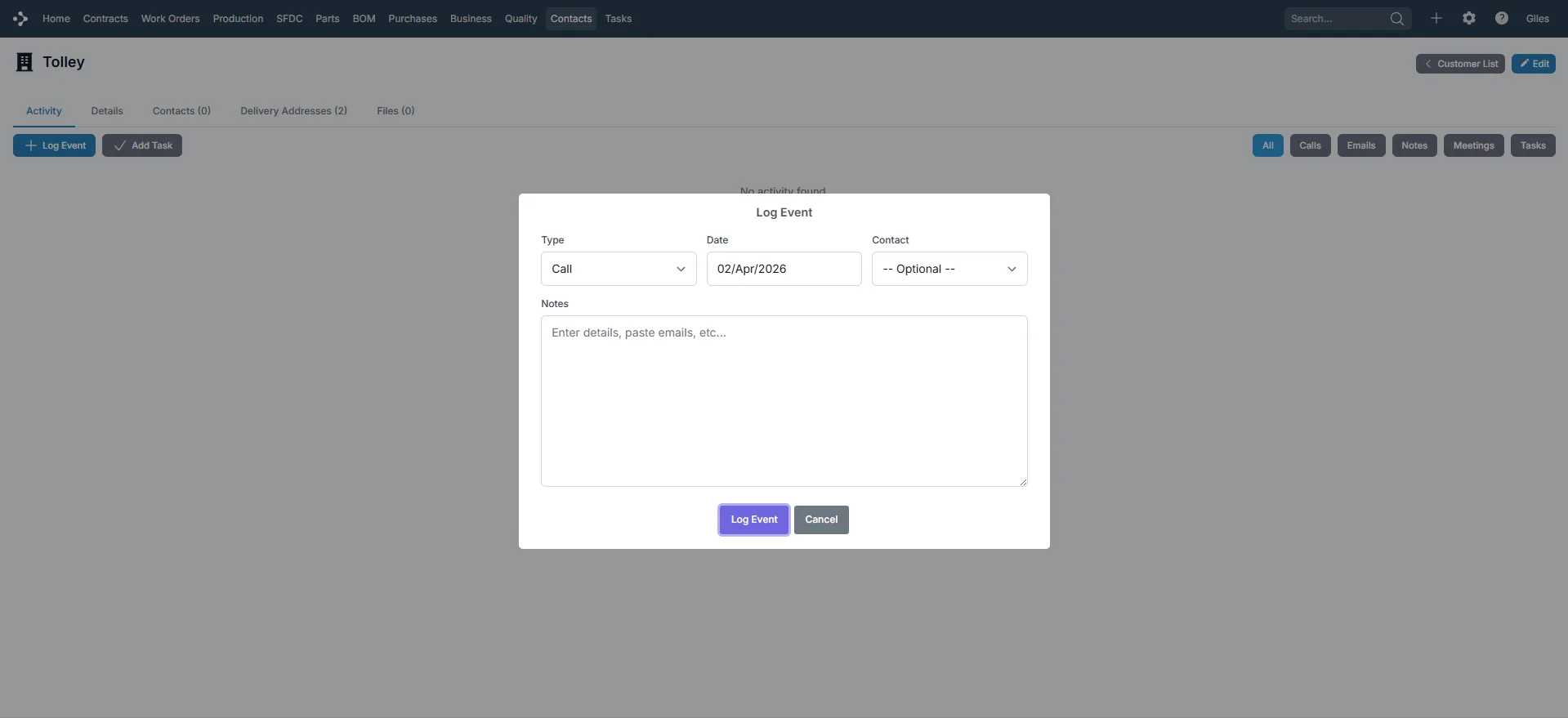
In Fraction ERP’s case, CRM actions link through the entire system, from customer records to production orders.
That means a business can follow the full journey:
- A customer enquiry is logged
- Account details and communication are captured
- The opportunity progresses to quotation or order
- The order feeds into planning and production
- Teams can track delivery against the original customer requirement
Instead of separate systems with broken links, the whole process stays connected.
4. Less duplication and fewer mistakes
Every time someone has to re-key customer or order information, there is a risk of delay or error.
A built-in CRM reduces repeated admin because data entered once can be used throughout the system. That saves time and improves accuracy.
For growing businesses, this matters. Small inefficiencies multiply quickly when order volumes rise.
5. Better reporting and decision-making
When CRM and ERP data sit together, reporting becomes far more useful.
You can look beyond simple sales activity and understand the wider picture, such as:
- Which customers generate the most profitable work
- Which quotes convert into real orders
- How customer demand affects production load
- Where delays occur between sales and fulfilment
- Which accounts create repeat business
That helps leaders make better decisions based on joined-up information, not isolated snapshots.
6. Improved customer experience
Customers expect joined-up communication.
They do not want to repeat information to different departments or be told that sales, production and accounts are all working from different systems.
When your CRM is part of your ERP, your team can respond with better context, faster updates and fewer internal misunderstandings. The result is a smoother experience for the customer and a more professional impression overall.
Why this matters for manufacturers and operational businesses
For manufacturers and other operationally complex businesses, the link between customer demand and delivery is critical.
A CRM should not just help win work. It should help the business deliver that work properly.
If customer requirements, order details and production activity are connected inside one ERP platform, teams can plan better, communicate better and reduce the risk of things slipping through the cracks.
That is especially important where lead times, specifications, scheduling and on-time delivery all matter.
Why Fraction ERP takes this approach
Fraction ERP is designed so CRM is not treated as a bolt-on extra.
Instead, CRM actions link through the whole system, from customer records to production orders. That gives businesses a more connected way to manage customer relationships and operational delivery in one place.
Rather than switching between disconnected tools, teams can work in a single system that supports the full process from first contact to fulfilment.
Final thought
If your CRM only helps you manage contacts and sales conversations, it is doing part of the job.
If it is built into your ERP and linked to the way work is planned, produced and delivered, it becomes much more powerful.
A connected CRM and ERP approach helps reduce duplication, improve visibility, strengthen handovers and create a better customer experience.
For businesses that want clearer processes and better control, that is a major advantage.